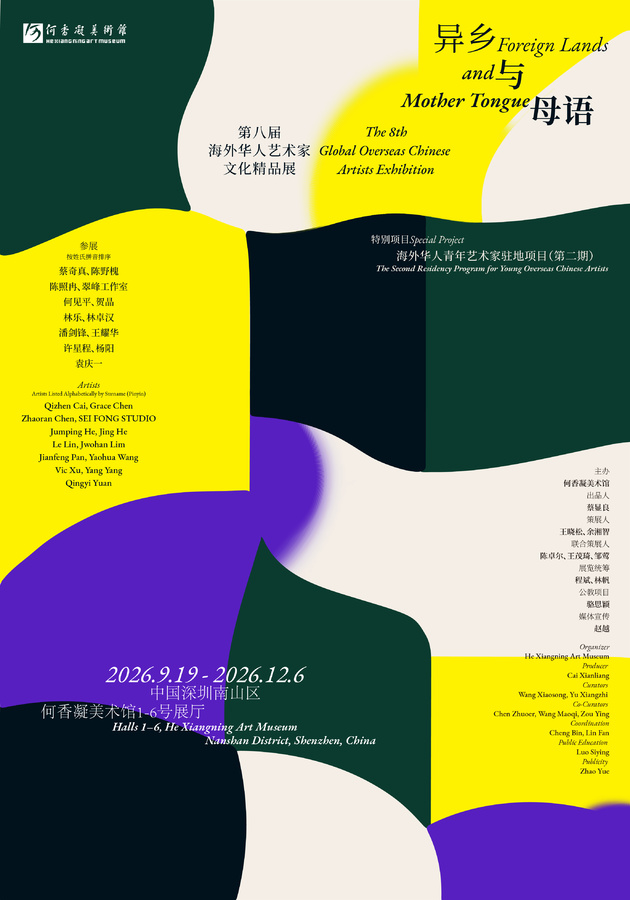
Exhibition Dates
2026.09.19 To 2026.12.06
Venue
He Xiangning Art Museum Hall 1-6
Organizer: He Xiangning Art Museum
Producer: Cai Xianliang
Curators: Wang Xiaosong, Yu Xiangzhi
Co-Curators: Chen Zhuoer, Wang Maoqi, Zou Ying
Artists: Cai Qizhen, Grace Chen, Zhaoran Chen, Sei Fong Studio, He Jianping, He Jing, Le Lin, Jwohan Lim, Pan Jianfeng, Yaohua Wang, Vic Xu, Yang Yang, Qingyi Yuan
Special Project: The Second Residency Program for Young Overseas Chinese Artists
Coordination: Cheng Bin, Lin Fan
Public Education: Luo Siying
Publicity: Zhao Yue
"Foreign land" and "mother tongue," two terms that seemingly belong to entirely different semantic categories, are remarkably apt when applied to immigrant communities. For the Chinese diaspora and their descendants, the relationship between land and language is complex: some leave their childhood homelands to navigate life in a foreign country using another language, while others are born abroad, speaking a "mother tongue" that does not necessarily connect to the cultural roots of a distant homeland. This continuous dislocation speaks to the fluidity and complexity of the diasporic Chinese identity. Simultaneously, it reflects the community’s adaptability and inclusivity when navigating multicultural and multilingual environments. Overseas Chinese artists and designers further transform these very characteristics into creative resources, cultivating rich and highly distinctive artistic and design practices.
Design is a discipline that demands both artistry and practicality. From the design and typography of multilingual text to 2D visual imagery such as books and posters, from the comprehensive visual wayfinding of an event to the material and pattern design of textiles, and even the architectural style of a city—a diverse array of designs subtly constitutes the myriad details of our daily lives.
When we observe the products and artistic designs of overseas Chinese artists and designers, what is embedded within is not merely a balance between aesthetics and utility, but also the lived experiences and personal reflections they have garnered from multicultural contexts and multi-perspective observations. This is not a simple juxtaposition, collage, or fusion; it can also be a discussion and representation of their own experiences, culture, and identity.
The relationship between a foreign land and a mother tongue is never static; it undergoes continuous transformation alongside personal experiences, the passage of time, and geographical migration. These very changes and nuances are exactly what this exhibition seeks to present.
Additionally, the museum's 2nd "Residency Program for Young Overseas Chinese Artists" is incorporated into this exhibition as a special unit. Four overseas Chinese artists based in the Netherlands, the United States, and Canada have created works that integrate Shenzhen’s local characteristics, drawing from four distinct approaches: artistic social research, art and technology, local botanical iconography, and the reclamation of self-identity. Together, these elements elevate the exhibition’s presentation to a new dimension in both subject matter and form.
He Xiangning Art Museum
Since 2014, overseas Chinese art exhibition projects have undergone changes in research themes, venues, and strategies—transitioning from "calligraphy and painting" to broader "art," from temporary to permanent setups, and from a bird's-eye perspective to the mapping of cultural and geographical routes. In response to external conditions, these shifts have continuously expanded the interface of the overseas Chinese community's role in the modern world.
It is gratifying that such a seemingly niche project—one that might even be dismissed due to preconceived "stances"—has gradually evolved into a platform converging various fields of research. This belated signal is crucial: it indicates that the post-globalization era has finally begun to confront the issue of global population mobility. The large-scale, multi-layered, and rapid "mobility" centered around people has shed its previously slow, almost static state to become a core proposition. Consequently, the Chinese diaspora, given its vast geographical distribution and immense population, has inevitably become a central topic within this discourse.
Through nearly a hundred interviews with overseas Chinese artists, we have come to realize that family stories, cultural legends, and everyday customs form the foundational undertone of how they understand and express the world behind their creative work. At a time when the efficacy of highly individualized expression is gradually diminishing, this compels us to investigate the extent to which the Chinese diaspora intervenes in social production through design, as well as the relationships they forge with domestic design in China.
The exhibition title, Foreign Lands and Mother Tongue, stems from our preliminary research on Chinese designers. We believe that beyond their specific professional output, this expression transcends concrete ethnic and spatial boundaries. It articulates the inner state of contemporary individuals searching for a "spiritual homeland" amidst the anxieties of normalized mobility and an increasingly alienated world.
The exhibition has not abandoned the fundamental roots of research on overseas Chinese visual culture; rather, it serves as a natural, inward extension within the broader framework of visual culture. Take typography—the core medium of visual communication—as an example. Whether they are ethnic Chinese designers living a "migratory" lifestyle between China and abroad, or those permanently based overseas, their cross-cultural and foreign- cultural experiences have expanded the design and application scope of Chinese fonts through new usage contexts and visual expressions.
Within a limited space and sample size, we have grounded the exhibition's narrative in the basic necessities of life—clothing, food, housing, and transportation. Every subtle design applied to everyday life inevitably influences the ultimate shape of the world. We hope that this dispersed Chinese design wisdom can converge into a force that is both recognized and seen.
Curators: Wang Xiaosong, Yu Xiangzhi
Co-curators: Chen Zhuoer, Wang Maoqi, Zou Ying